Polynesian Introduction Plants
Plants brought by Polynesian settlers to Hawaiʻi are called Polynesian Introduction Plants, or Canoe Plants. Polynesian settlers brought between twenty-four and thirty-six plants with them when they settled the Hawaiian Islands. Most of these plants had practical purposes for survival and many of them were food crops. As the Hawaiian culture emerged, farming methods, particularly new irrigation techniques, allowed for the expansion of the population.
Hawaiian farmers became highly skilled at their craft. Hawaiian farmers developed a wealth of practical knowledge and a host of agricultural skills that they applied to cultivation. Hawaiians developed an accurate system of identification and differentiation that is well demonstrated by the 300 named varieties of kalo. Farmers were knowledgeable about plant anatomy as well as the habits and the requirements of their crops. They had highly developed procedures for cultivation and adapted farming methods to various climates, terrains, altitudes, and soil conditions. Hawaiians experimented in creating sub-varieties of crops and understood the principles of pollination. They had an intimate understanding of weather signs with regard to clouds, mists, winds, and general atmospheric conditions. Their agricultural engineering skills are evident in their terraces, irrigation ditches, aqueducts, and fishponds that remain today. The farmer practiced his craft with few tools. His hands and feet served as rake, hoe, trowel, and plow. Sharp shells and stones were used for cutting and weeding. The stone adze was used for chopping and hewing trees, and fire was also used to clear land. The primary tool of the farmer was the ʻōʻō, the digging stick, and many ʻōʻō were treated as prized possessions and family heirlooms. Other tools were pālau, a sharpened piece of wood for cutting kalo, and ʻauamo, carrying poles (Handy, Handy and Pukui 21-28).
The primary food crops of Mānoa were kalo and ʻuala. The valley floor was covered in loʻi kalo and on the western slope of the valley near Puʻu o Mānoa (Rocky Hill) is ʻUalakaʻa, a place famous in legend for its sweet potatoes as the name implies. One story tells of the danger of being hit by large sweet potatoes while walking past this area. Behind Kūkaʻōʻō was a place known as Ulumalu, or breadfruit shade, where it is said a wonderful grove of breadfruit trees provided a welcomed shade. Bananas and sugarcane were not as systematically cultivated as kalo and ʻuala. Instead, they were planted wherever it was conducive to their growth, often on the embankments between the loʻi kalo. Coconuts may have been individually planted in the valley, but the large groves of coconuts were found near the shore. Every part of this tree was useful to Hawaiians and it is said that only a chief could cut down a coconut tree. The willful destruction of one chief’s coconut grove by another was considered a declaration of war.
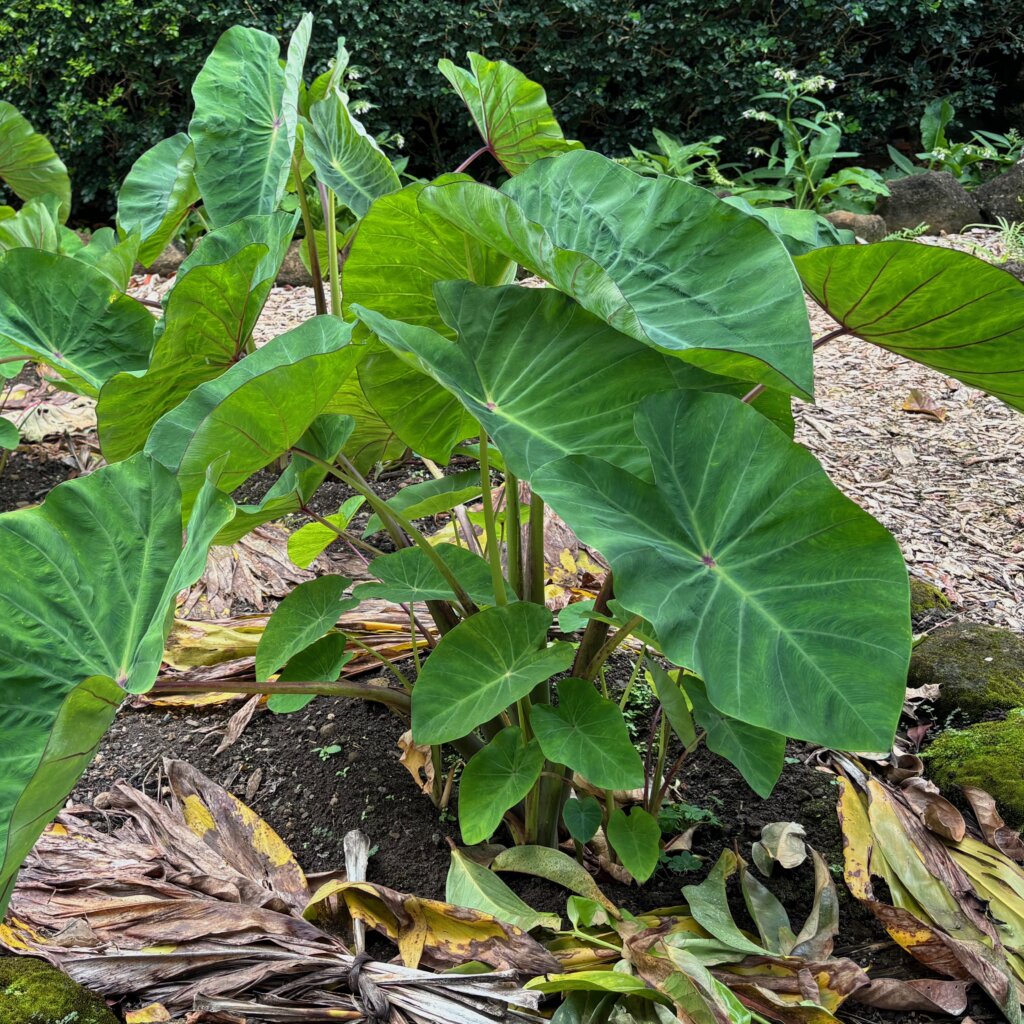
(Colocasia sp)
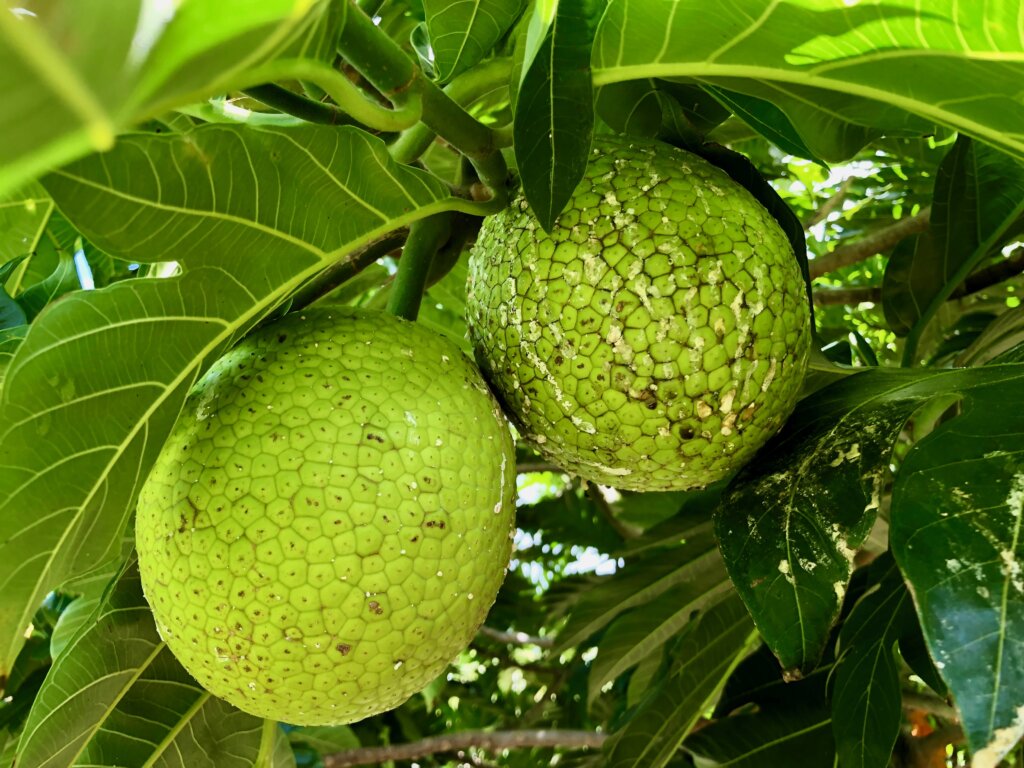
(Artocarpus sp)
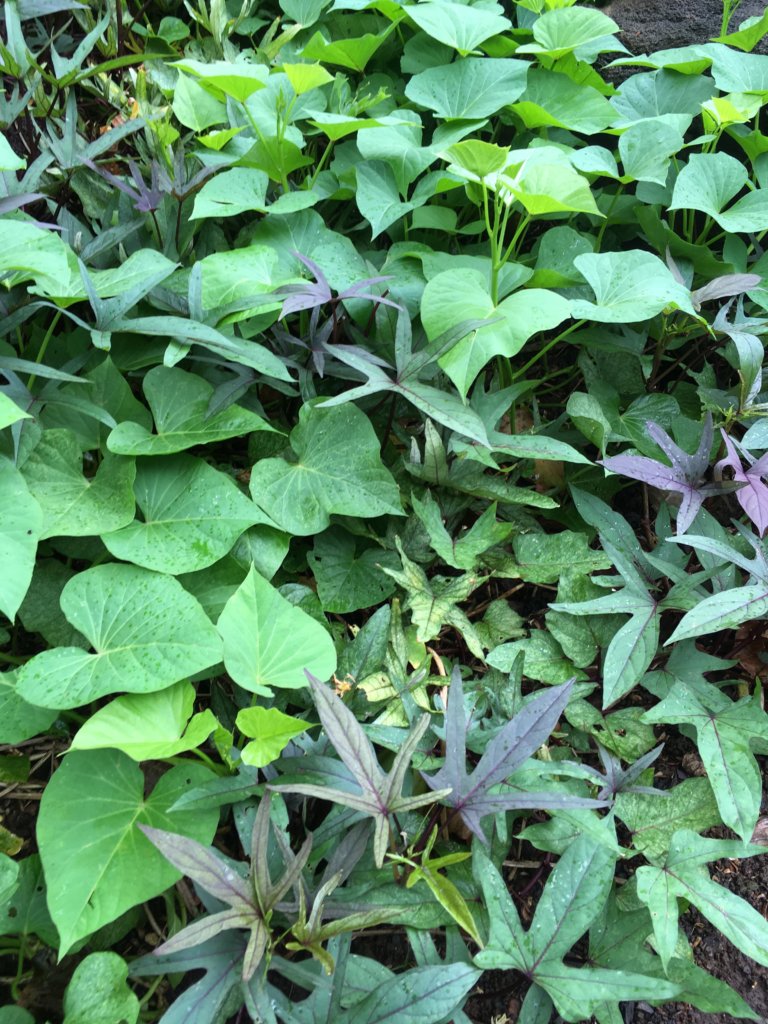
(Ipomoea sp)
Water is essential for growing kalo, the staff of life for the Hawaiians of old. Healthy kalo requires a cool water temperature that is maintained by water flow. Nowhere else is the skillful management of a natural resource so evident in Hawaiian society as with the system by which water was managed. Natural resources such as land and water were never thought of as property. Although the ruling chief held stewardship over the land, inalienable title or private property ownership were concepts unknown in Hawaiian thinking (Handy, Handy and Pukui 63).
In a valley such as Mānoa, with an abundantly flowing stream, water was diverted to the loʻi kalo (pondfields) by means of an ʻauwai or irrigation ditch. The building and maintenance of these ʻauwai were communal activities. The ruling chief’s land agent, the konohiki, oversaw the building of the ʻauwai, their maintenance, and the subsequent distribution of water. The right to use the water from the ʻauwai was based on communal cooperation in building and maintenance, as well as the demonstration of “good faith efforts” to make one’s crops succeed. This system encouraged industry, and a person could acquire the right to use more water (and grow more crops) through diligent crop productivity or through increased contributions to maintenance.
The method of water distribution differed, but the best-known methods were by time. Farmers would be allowed to take water to their fields on certain days of the week or at certain times of the day. The days or hours that water would be allowed to flow through their fields was determined by the konohiki or his representative, the luna wai, and was usually determined by need. When one tract received its allotment, the water flow was stopped and opened to another farmer’s tract. The ʻauwai returned unused water to the stream. This system depended on honest communal cooperation. In dry seasons, the konohiki adjusted the allotment accordingly. Violations of this communal system were not taken lightly by the konohiki or by the farmers. Consistently taking more than one’s share could have serious consequences, and the malicious interference or destruction of an irrigation dam or ditch was sometimes punished by death (Perry 91-93).
It should be noted that this system of water use somewhat changed the stream flow, but it did not do the ecological damage we see today in many of the valley streams due to contemporary water management practices. Decreased water flow in a stream leads to higher water temperature that encourages parasite growth, which in turn decreases or wipes out native species. In addition, weakened stream flow results in fewer nutrients entering the ocean through the stream. The life cycle of certain fish populations depends on these nutrients and a lack of nutrients is known to cause depleted fish populations.
Hawaiian words illustrate how important the natural resource of water was within the culture. Wai means water, when duplicated as waiwai, it means wealth or prosperity. Kānāwai, belonging to the waters, has come to mean law, evolving perhaps from a person’s right to enjoy the privilege of water use while conceding the same right to his fellow man (Handy, Handy and Pukui 58).